Introduction
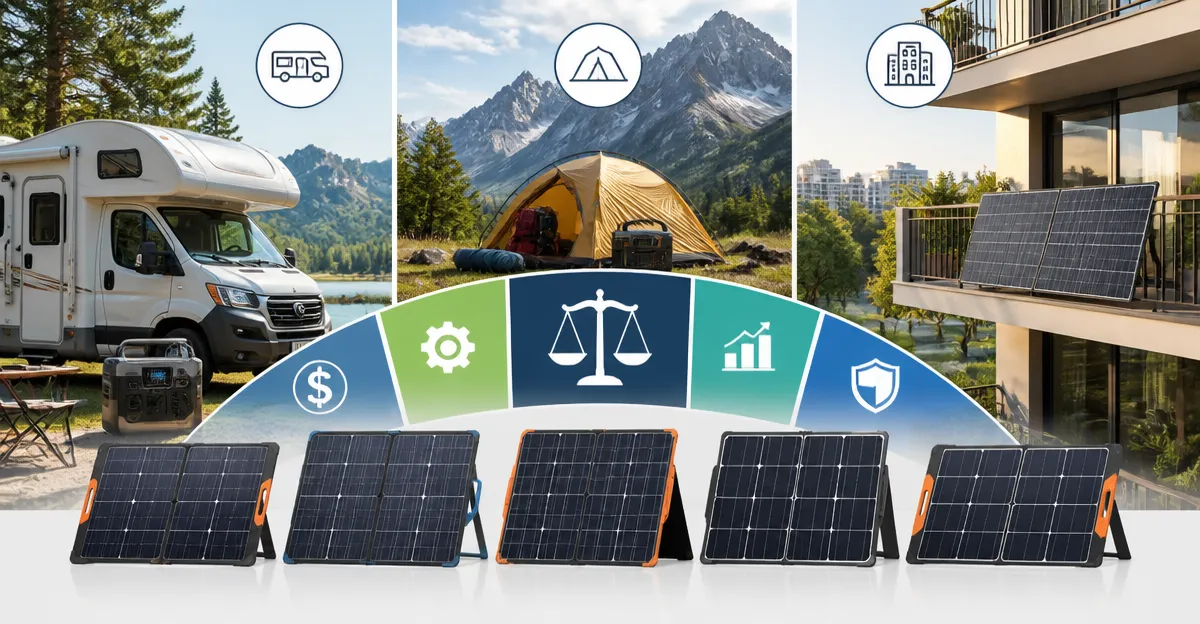
Solar power continues to dominate the off‑grid market, yet the variety of panels available on Amazon can overwhelm even seasoned users. This article compares five popular Amazon listings—Callsun 400W Bifacial Solar Panel, Renogy 200W Portable Solar Panel, ECO‑Worthy 400W Solar Panels, FlexSolar 100W Foldable Solar Panel, and STAR 495W Bifacial Solar Panel. Understanding their differences matters because each design targets distinct scenarios such as RV roofs, backpacking, or large‑scale DIY arrays.
The comparison focuses on price, technical specifications, real‑world performance, and customer sentiment. By the end, readers will know which panel best fits a van conversion, a weekend hike, or a permanent off‑grid home.
Individual Product Overviews
Callsun 400W Bifacial Solar Panel
The Callsun offering consists of two 200 W N‑type 16BB modules that can be wired in series for a combined 400 W output. With a claimed 25.6 % conversion efficiency, a low temperature coefficient of –0.30 %/K, and a robust IP68‑rated junction box, the panel is built for hot‑climate reliability. The bifacial design captures reflected light, while the TwinCell anti‑shading architecture splits the panel into two independent sections, reducing power loss when part of the array is shaded.
Customer reviews highlight real‑world output above rating: one user reported 369 W on a sunny day and 986 W from four panels in April, noting the “bifacial is for real” boost. The panel weighs 23.8 lb per unit and measures 51.3 × 30.3 × 1.4 in, making it compact for RV roofs.
Renogy 200W Portable Solar Panel
Renogy’s 200 W portable panel uses 16BB N‑type cells to reach a 25 % efficiency rating. It folds into a backpack‑size package (23.72 × 22.99 × 1.97 in) and weighs 13.89 lb, with magnetic handles for quick closure. The panel supplies three USB ports (45 W PD C, 18 W A, 15 W A) and an MC4 output for 12 V‑24 V systems, making it versatile for camping, marine, and emergency backup.
Reviewers praise its portability and “90 % efficiency on a hot sunny day,” but note that the fixed 23.4 V VOC limits its use with higher‑voltage charge controllers. The included 3‑ft MC4 cable is short, prompting users to purchase longer, heavier gauge extensions for minimal loss.
ECO‑Worthy 400W Solar Panels
ECO‑Worthy sells a four‑panel kit, each rated at 100 W N‑type bifacial cells with 25 % efficiency. The panels are thin (1.18 in) and feature pre‑installed bypass diodes in an IP68 junction box, improving low‑light performance. The kit includes 35‑in cables and plug‑and‑play connectors, targeting DIY installers for 12 V/24 V off‑grid systems.
Customers emphasize consistent output even on partly cloudy days and note a “meaningful reduction in electric bill.” One reviewer reported each panel delivering well over 20 A in full sun, keeping two 100 Ah batteries fully charged.
FlexSolar 100W Foldable Solar Panel
FlexSolar’s 100 W foldable panel weighs only 4.1 lb and folds to a notebook‑size footprint (12.99 × 10.43 × 2.17 in). Monocrystalline cells deliver >23 % efficiency, and the panel provides three outputs: 45 W PD‑C USB‑C, 18 W USB‑A, and 100 W DC with a 4‑in‑1 cable (DC5521, DC7909, Anderson, XT60). The unit meets IP67 standards for water and dust protection.
Reviewers appreciate the lightweight design and included case, yet they cite difficulty angling the folded panel for optimal sun exposure and occasional heat buildup in the DC circuitry under high loads.
STAR 495W Bifacial Solar Panel
STAR’s 495 W bifacial panel adopts a frameless “Cleanedge” design that reduces dust accumulation and enables self‑cleaning with rain. The panel uses 16BB N‑type cells for 25 % efficiency and claims up to 15 % more power than conventional frames. A 12‑year quality warranty and a 30‑year linear power output warranty back the product.
Positive owners report exceeding the rated 870 W (two panels) with outputs up to 940 W in full sun. The panel’s large size (approx. 65 × 39 in) and weight (≈ 45 lb) suit van conversions and permanent installations rather than backpacking.
Head‑to‑Head Comparison
Price and Value
- Callsun: $345.99 for a pair (2 × 200 W) – $172 per 200 W module.
- Renogy: $219.99 for a single 200 W portable panel – higher price per watt but includes magnetic handles and USB ports.
- ECO‑Worthy: $219.59 for four 100 W panels – $54.90 per 100 W, making it the most cost‑effective for larger DIY arrays.
- FlexSolar: $89.99 for a 100 W foldable panel – lowest absolute price, but lower wattage and limited durability under high load.
- STAR: $659.99 for two 495 W panels – $335 per 495 W, premium price justified by frameless design and long‑term warranties.
Features and Specifications
| Callsun 400W | Renogy 200W | ECO‑Worthy 400W | FlexSolar 100W | STAR 495W |
|---|---|---|---|---|
| 2 × 200 W N‑type 16BB, Bifacial | 200 W N‑type 16BB, Foldable | 4 × 100 W N‑type 16BB, Bifacial | 100 W Monocrystalline, Foldable | 2 × 495 W N‑type 16BB, Frameless Bifacial |
| 25.6 % efficiency | 25 % efficiency | 25 % efficiency | 23 %+ efficiency | 25 % efficiency |
| Dimensions per panel: 51.3 × 30.3 × 1.4 in | Folded: 23.72 × 22.99 × 1.97 in | Dimensions: 65 × 39 in (approx.) | Unfolded: 45.47 × 26.18 in | Dimensions per panel: 65 × 39 in (approx.) |
| Weight per panel: 23.8 lb | 13.89 lb | ~11 lb per 100 W panel | 4.1 lb | ≈45 lb per 495 W panel |
| IP68 junction box | IP65 rating | IP68 junction box | IP67 rating | UL61730, IP67 |
| Temperature coeff: –0.30 %/K | Not specified | Not specified | Not specified | Not specified |
| Warranty: 10 yr support, 25‑yr performance | 2‑yr material & workmanship | Not specified | Not specified | 12‑yr quality, 30‑yr output |
Customer Ratings and Feedback
All products maintain strong Amazon ratings (4.4‑4.8/5). Callsun leads with 4.8/5 from 439 reviews, praised for “solid build” and “consistent output even in winter.” Renogy holds 4.5/5 from 938 reviews; users love portability but warn about short MC4 cables. ECO‑Worthy’s 4.5/5 from 618 reviews emphasizes reliable power and easy DIY installation. FlexSolar’s 4.4/5 from 331 reviews highlights ultra‑light weight yet notes difficulty angling the panel. STAR’s 4.4/5 from 137 reviews receives accolades for high power density and frameless aesthetics.
Performance and Reliability
- Callsun’s bifacial design delivers up to a 25 % boost in optimal conditions, with real‑world users reporting 369 W from a single 200 W unit and 986 W from four panels in April.
- Renogy’s portable panel typically produces 90‑95 W in full sun, matching its 25 % efficiency claim, but performance drops noticeably under shade due to the single‑cell layout.
- ECO‑Worthy’s four‑panel kit consistently exceeds 20 A per panel in full sun, keeping 100 Ah batteries fully charged, and maintains output during cloudy periods thanks to bypass diodes.
- FlexSolar reaches 80‑85 W peak on a hot day, but heat buildup in the DC circuitry can affect long‑term durability under continuous high load.
- STAR’s frameless panels achieve 15 % more power than framed equivalents; users have measured 940 W from two 495 W units, confirming the manufacturer’s power‑boost claim.
Best Use Cases
- Callsun 400W: Ideal for RV roofs, van conversions, and off‑grid cabins where space is limited but high wattage is required.
- Renogy 200W Portable: Perfect for backpacking, car camping, and short‑term trips where weight and quick setup matter.
- ECO‑Worthy 400W Kit: Suited for DIY homeowners expanding an existing 12 V/24 V system, small farms, or shed installations.
- FlexSolar 100W Foldable: Best for hikers, cyclists, and emergency kits that need ultra‑compact power for phones and small power stations.
- STAR 495W: Designed for permanent van installations, tiny houses, or commercial off‑grid projects where maximum power per square foot is critical.
Pros & Cons
Callsun 400W Bifacial Solar Panel
- Pros: High 25.6 % efficiency, bifacial boost, anti‑shading TwinCell design, robust IP68 build, excellent temperature coefficient.
- Cons: Heavier than portable options, requires series wiring for full 400 W, cables slightly short for some installations.
Renogy 200W Portable Solar Panel
- Pros: Lightweight, magnetic closure, USB‑C PD port, 25 % efficiency, versatile charging options.
- Cons: Fixed 23.4 V VOC limits high‑voltage systems, short MC4 cable, performance drops sharply with shade.
ECO‑Worthy 400W Solar Panels
- Pros: Cost‑effective kit, bifacial cells, IP68 junction box, pre‑installed bypass diodes, thin profile for easy mounting.
- Cons: Requires purchase of additional mounting hardware, no integrated USB ports, larger total footprint.
FlexSolar 100W Foldable Solar Panel
- Pros: Ultra‑lightweight, foldable to notebook size, three output options, IP67 protection.
- Cons: Difficult to angle for optimal sun, heat buildup under high DC load, no MC4 connector.
STAR 495W Bifacial Solar Panel
- Pros: Frameless design reduces cleaning costs, high power density, 30‑year output warranty, UL61730 certified.
- Cons: Premium price, heavier and larger, installation may require professional mounting.
Recommendations by Use Case
RV or Van Roof Upgrade: Callsun 400W Bifacial Solar Panel offers the best balance of power, durability, and anti‑shading protection for limited roof space.
Backpacking or Car Camping: FlexSolar 100W Foldable Solar Panel provides the lightest, most portable solution, despite the need for careful angling.
DIY Home or Shed Expansion: ECO‑Worthy 400W Solar Panels give the lowest cost per watt and include everything needed for a quick install.
Short‑Term Power Station Charging: Renogy 200W Portable Solar Panel excels with built‑in USB‑C PD and multiple ports, ideal for charging laptops and phones while on the move.
Maximum Power for Fixed Installations: STAR 495W Bifacial Solar Panel delivers the highest wattage per square foot and long‑term warranties, perfect for commercial or high‑usage residential setups.
FAQ
- 1. Can I connect Callsun panels to a 12 V battery?
- Yes. When wired in series, two 200 W panels produce 47.48 V Vmp, which is suitable for 12 V/24 V charge controllers that accept up to 60 V input.
- 2. Does the Renogy panel work in low‑light conditions?
- Its 25 % efficiency helps, but output falls proportionally; users report about 50 % of rated power under overcast skies.
- 3. Are ECO‑Worthy panels truly bifacial?
- They are marketed as bifacial N‑type cells; real‑world reviews confirm higher output when installed with reflective ground surfaces.
- 4. How do I protect FlexSolar’s DC circuitry from heat?
- Mount the panel on a metal frame with airflow, avoid continuous 100 W DC loads for more than an hour, and consider a small heat‑sink accessory.
- 5. What maintenance does the STAR frameless design require?
- Because there is no frame to trap dust, rain typically washes the surface clean; occasional inspection for micro‑cracks is advised.
- 6. Which panel offers the longest performance warranty?
- STAR provides a 30‑year linear output warranty plus a 12‑year quality warranty, surpassing Callsun’s 25‑year performance guarantee.
Conclusion
Each of the five solar panels excels in a specific niche. Callsun’s 400 W bifacial pair delivers high efficiency and anti‑shading resilience for RVs and permanent roofs. Renogy’s portable 200 W panel balances weight, USB versatility, and solid efficiency for on‑the‑go charging. ECO‑Worthy’s four‑panel kit offers the best cost‑per‑watt for DIY homeowners. FlexSolar’s ultra‑light 100 W foldable unit is unmatched for backpackers, while STAR’s premium 495 W frameless panels provide unmatched power density and warranty protection for large‑scale installations. Buyers should match the panel to their primary use case, budget, and installation constraints to achieve optimal value.
Products Mentioned in This Review
Frequently Asked Questions
Which panel offers the best power‑to‑weight ratio for backpacking?
The FlexSolar 100W foldable panel is the lightest per watt, making it ideal for backpacking trips.
Are bifacial panels like Callsun and STAR suitable for RV roofs?
Yes, their dual‑sided design boosts output on angled RV roofs, especially when reflected light is available.
How does the performance of the 400W ECO‑Worthy compare to the 400W Callsun?
ECO‑Worthy delivers similar peak power but typically has a lower efficiency rating, so Callsun often produces more energy in limited space.
Will installing a balcony solar panel affect my apartment insurance premium?
Most insurers treat small balcony panels as a low‑risk addition, but you should notify your provider to confirm any premium changes.
What factors should I consider when choosing between foldable and rigid panels for a DIY array?
Consider installation space, durability, weight, and efficiency; foldable panels are portable, while rigid panels usually offer higher efficiency and longer lifespan.