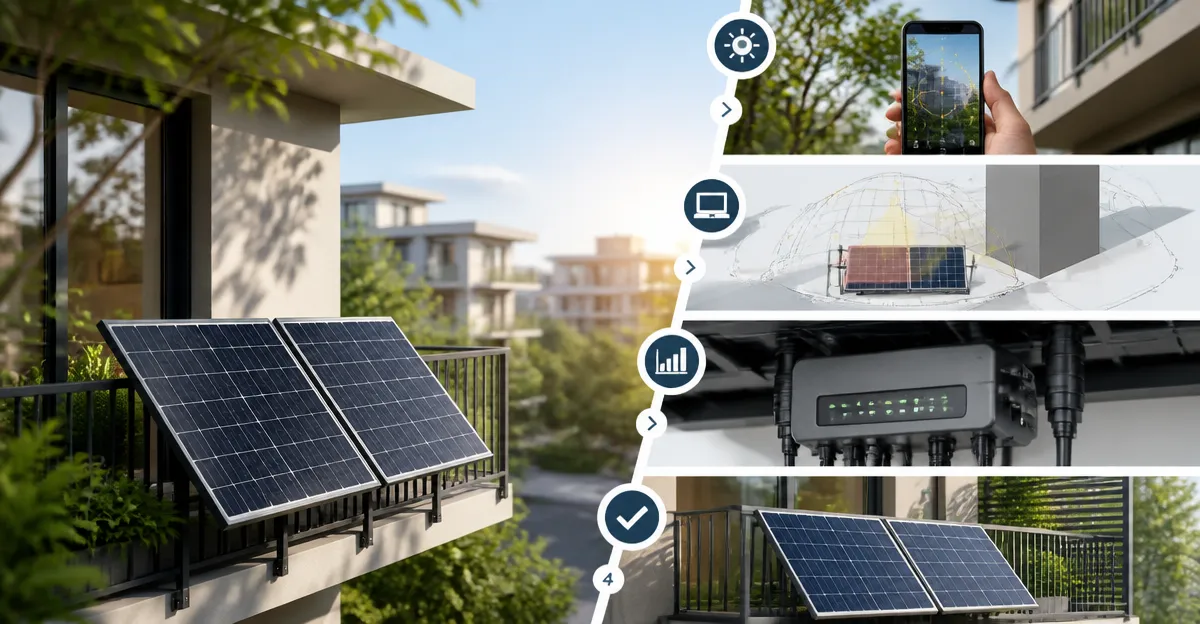
How to Analyze and Mitigate Shading on Balcony Solar Panels: Step-by-Step Guide to Maximize Energy Production
Balcony solar installations often suffer from partial shading caused by nearby trees, awnings, or adjacent buildings. This guide will teach the reader how to assess shading, use analytical tools, and apply practical mitigation techniques to increase energy production. By following the steps, one can transform a modest balcony array into a reliable power source for off‑grid devices, home backup, or electric vehicle charging.
What You’ll Need
- Solar shading analysis tool (e.g., solar pathfinder or smartphone app)
- Measuring equipment (multimeter, clamp meter)
- Mounting hardware suitable for balcony railings or flat surfaces
- High‑efficiency solar panels with anti‑shade features (recommended products are listed below)
- Safety gear (gloves, eye protection)
Step 1: Observe Sun Path and Record Shading Patterns
Begin by standing on the balcony at sunrise, solar noon, and sunset. Note any objects that cast shadows on the panel location. Use a notebook or a digital note‑taking app to record the time, direction, and length of each shadow. This manual observation creates a baseline that will be refined with digital tools later.
Step 2: Use a Solar Pathfinder or Smartphone App for Precise Analysis
Digital analysis provides a more accurate sun‑path diagram. A solar‑pathfinder device or a reputable smartphone application can generate a shading map based on geographic coordinates and date. Input the balcony dimensions and surrounding obstacles; the software will highlight critical shading periods. For users who prefer a ready‑made solution, the ECO‑WORTHY 400W Solar Panels package includes pre‑drilled mounting holes and a lightweight frame that simplifies placement after the analysis is complete.
Key reasons to choose ECO‑WORTHY panels for this step:
- 25% conversion efficiency with N‑type cells, providing strong output even when part of the array is shaded.
- Pre‑installed bypass diodes reduce power loss caused by partial shading.
- Price of $219.59 and a rating of 4.4/5 from 616 reviews indicate good value.
Step 3: Measure Panel Output at Different Times
Connect a multimeter or clamp meter to a single panel and record voltage and current at the times identified in Step 1. Multiply voltage by current to calculate instantaneous power (P = V × I). Compare these measurements with the panel’s rated output. Significant deviations indicate shading impact that must be mitigated.
Step 4: Choose Panels with Anti‑Shade Technology
When shading cannot be eliminated completely, select panels that tolerate partial shade. The Callsun 400W Bifacial Solar Panel employs TwinCell anti‑shade design, splitting the panel into two independent halves. If one half is shaded, the other continues to generate power, reducing overall loss by up to 50% compared with conventional panels.
Product highlights:
- Dual‑module parallel design for shade tolerance.
- Bifacial cells capture reflected light, increasing output by up to 30%.
- Low temperature coefficient of –0.3%/K ensures stable performance in hot climates.
- Price $345.99, rating 4.7/5 from 230 reviews, and a 10‑year support guarantee.
Step 5: Optimize Mounting Angle and Height Using Flexible Panels
Balconies often have limited vertical clearance. A flexible panel can conform to irregular railings or curved surfaces, allowing the installer to achieve the optimal tilt angle (typically 30°–45°) without adding bulky frames. The Viewsun 200W Flexible Solar Panel is ultra‑thin (2 mm) and lightweight (2.97 lb), making it ideal for this purpose.
Key advantages:
- Can bend to a 30° arc, fitting balcony railings or sloped roofs.
- IP67 waterproof junction box protects against rain.
- Price $89.29 and rating 3.9/5 from 20 reviews provide an affordable entry point.
Step 6: Implement Bifacial or Dual‑Module Designs for Maximum Harvest
If the balcony floor or wall reflects sunlight, a bifacial panel can harvest rear‑side irradiance. Both Callsun and AeternaSol panels feature bifacial technology. The AeternaSol 200W Bifacial Solar Panel offers 18 Busbars, IP68 waterproofing, and up to 15% additional energy from reflected light.
Why choose AeternaSol for this step:
- High‑efficiency N‑type cells with 25.6% efficiency.
- Robust IP68 rating for harsh balcony environments.
- Price $119.98 and rating 4.6/5 from 13 reviews demonstrate strong performance‑to‑price ratio.
Step 7: Add Micro‑Inverters or Power Optimizers if Budget Allows
When multiple panels are installed, a micro‑inverter per panel or a power optimizer can isolate shading effects, ensuring that a shaded panel does not reduce the output of the entire string. Although specific models are not listed in the product data, the principle remains valuable for balcony systems that combine different panel types.
Step 8: Maintain Cleanliness and Trim Obstructions
Even a small amount of dust or a low‑hanging plant can create micro‑shades. Schedule monthly cleaning with a soft brush and mild soap. Trim tree branches that extend over the balcony during the growing season. For heavy‑duty mounting, the DOKIO 800W Solar Panel Set provides sturdy frames and pre‑installed MC4 leads, reducing the need for additional hardware when securing larger arrays.
Product benefits:
- Two 400W panels deliver high power density, reducing the number of mounts required.
- 3 m leads simplify wiring on balcony rails.
- Price $494.77, rating 4.1/5 from 499 reviews indicate reliable construction.
Tips & Pro Tips
- Use a reflective surface (white paint or light‑colored decking) beneath bifacial panels to maximize rear‑side gain.
- When possible, orient panels toward true south (in the Northern Hemisphere) to capture the longest sun exposure.
- Install a small tilt‑adjustable bracket so the angle can be changed seasonally.
- Document performance data before and after each adjustment to quantify improvements.
Troubleshooting
| Problem | Possible Cause | Solution |
|---|---|---|
| Power drops sharply in the afternoon | Shading from adjacent building | Re‑position panel or add a reflective backing. |
| Panel output lower than rated even in full sun | Dirty surface or degraded cells | Clean panel and verify connections; consider a replacement with anti‑shade technology. |
| Inconsistent voltage readings | Loose MC4 connectors | Secure all connectors and inspect for corrosion. |
Conclusion
By systematically observing shading, employing analytical tools, selecting anti‑shade panels, and optimizing mounting, one can substantially increase the energy yield of balcony solar installations. The recommended products—Callsun 400W Bifacial Solar Panel, Viewsun 200W Flexible Solar Panel, ECO‑WORTHY 400W Solar Panels, DOKIO 800W Solar Panel Set, and AeternaSol 200W Bifacial Solar Panel—provide a range of options for different budget levels and space constraints. Implement the steps, monitor performance, and enjoy reliable, clean power from a previously underutilized balcony.
Products Mentioned in This Guide
Frequently Asked Questions
How can I tell if shading is reducing my balcony solar panel output?
Monitor the panel’s voltage and current at different times of day; sudden drops during specific periods indicate shading.
What tools are most effective for analyzing shading on a balcony?
A solar pathfinder or a smartphone sun‑tracking app can map sun angles and highlight shadowed zones.
Which mitigation methods provide the biggest gain against shading?
Using micro‑inverters or power optimizers and repositioning panels to avoid peak shadows are the most impactful.
Do anti‑shade solar panels really help on partially shaded balconies?
Yes, panels with bypass diodes or shaded‑cell tolerant technology maintain higher output when only part of the array is shaded.
How frequently should I re‑evaluate shading after installation?
Check shading quarterly and after any new construction or foliage changes to keep performance optimal.