Introduction
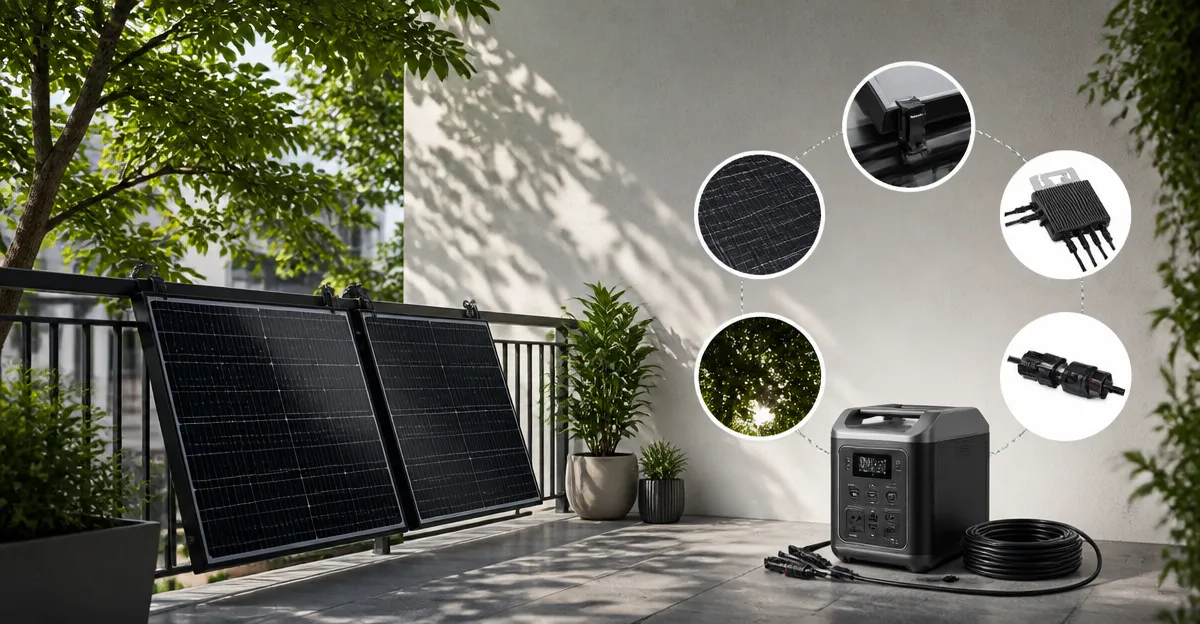
Balconies that receive only partial sunlight present a unique challenge for renewable energy enthusiasts. This guide explains how to evaluate light availability, choose solar kits that perform well in low‑light environments, and install them safely on limited space. Readers will gain a solid understanding of key technical concepts, see real‑world product recommendations, and learn practical tips for long‑term reliability. By the end of the article, one will be able to make an informed purchasing decision without feeling overwhelmed.
Background/Context
Solar photovoltaic (PV) panels convert photons into electrical current, but their output depends directly on the intensity and duration of sunlight. In shaded balconies, the daily insolation may be reduced to 2–4 hours of direct sun, and diffuse light often dominates. Modern monocrystalline cells maintain higher efficiency under such conditions because they have a tighter crystal lattice that reduces electron recombination. Understanding the relationship between panel efficiency, tilt angle, and shading patterns is essential before selecting a kit.
Typical balcony dimensions range from 1.5 m² to 3 m², limiting the number of panels that can be mounted. Consequently, the total wattage of a kit should match the available roof‑area while providing enough power for low‑draw devices such as LED lighting, phone chargers, or a small refrigerator. In addition, the charge controller must be compatible with the chosen battery chemistry, whether lead‑acid, AGM, or lithium‑ion, to prevent over‑charging and extend battery life.
Key Concepts for Low‑Light Solar Power
1. Panel Efficiency – Measured as a percentage of sunlight converted to electricity; higher efficiency panels generate more power per square foot. 2. Temperature Coefficient – Indicates how much output drops as temperature rises; a lower coefficient is preferable for rooftop installations that can become hot. 3. Charge Controller Type – PWM controllers are simple and cost‑effective, while MPPT controllers extract maximum power from panels under variable illumination. 4. Battery Capacity – Determines how long the system can supply power during periods of cloud cover; larger capacity reduces the need for frequent recharging.
When sunlight is intermittent, an MPPT controller can improve overall energy harvest by up to 30 % compared with a PWM controller. However, MPPT units are more expensive and may be unnecessary for very small kits that produce modest power. For most balcony applications, a high‑efficiency monocrystalline panel paired with a reliable PWM controller offers a balanced solution.
Product Recommendations for Shaded Balconies
The following products have been selected because they combine high‑efficiency cells, robust frames, and charge controllers that suit low‑light scenarios. Each recommendation includes key specifications, customer sentiment, and a direct link to the Amazon product page.
1. ECO‑WORTHY 200W Solar Kit
- High‑performance monocrystalline cells deliver up to 21.5 % greater efficiency than standard panels.
- Includes a 30 A PWM charge controller with USB ports for convenient device charging.
- Durable aluminum alloy frame rated for 2400 Pa wind and 5400 Pa snow loads, ensuring longevity on exposed balconies.
- Price: $169.98; Rating: 4.6 / 5 (1,140 reviews).
Customers praise the kit’s ease of installation and reliable charging even when panels are angled sub‑optimally, making it a strong candidate for shaded balconies where perfect sun exposure is rare.
2. Renogy 400W Solar Kit
- Four 100 W monocrystalline panels paired with a 40 A MPPT charge controller for superior low‑light performance.
- Maximum battery voltage of 32 V and input voltage tolerance up to 100 V, allowing flexible series/parallel configurations.
- Integrated Bluetooth module and DC Home app provide real‑time monitoring and performance analytics.
- Price: $574.19; Rating: 4.5 / 5 (576 reviews).
Reviewers note that the MPPT controller extracts more power on cloudy days, which is valuable for balconies that receive only scattered sunlight throughout the day.
3. Renogy 100W Solar Starter Kit
- 22.5 % cell efficiency with UL, CSA, and IEC certifications for safety and durability.
- 30 A PWM controller includes Bluetooth connectivity for optional remote monitoring.
- IP65‑rated junction box and IP67 connectors protect against moisture, a common concern on exposed balconies.
- Price: $132.99; Rating: 4.7 / 5 (4,011 reviews).
This compact kit is ideal for users who need a lightweight solution that can be mounted on a balcony railing or a small tilt frame.
4. Hoysicy 100W Solar Panel Kit
- Monocrystalline silicon cells claim up to 30 % higher efficiency than ordinary silicon, beneficial in low‑light conditions.
- Smart charge controller with LCD display, USB ports, and comprehensive protection features.
- All‑weather aluminum frame and waterproof junction box rated for harsh environments.
- Price: $109.99; Rating: 4.3 / 5 (80 reviews).
Users appreciate the built‑in LCD for quick status checks, which helps fine‑tune panel orientation when only limited sunlight is available.
5. Renogy 200W RV Solar Kit
- Two 100 W monocrystalline panels with 22 % efficiency and a 30 A PWM Adventurer‑Li controller.
- IP67 protection and a temperature range from –40 °F to +194 °F, suitable for year‑round balcony use.
- Pre‑drilled mounting holes and plug‑and‑play cables simplify installation on limited balcony space.
- Price: $257.39; Rating: 4.6 / 5 (542 reviews).
Positive feedback highlights the kit’s robust construction and reliable charging even when panels receive only indirect sunlight.
Comparison and Selection Guide
| Feature | ECO‑WORTHY 200W | Renogy 400W | Renogy 100W Starter | Hoysicy 100W | Renogy 200W RV |
|---|---|---|---|---|---|
| Panel Efficiency | ~21.5 % | ~22 % | 22.5 % | ~30 % higher than ordinary silicon | 22 % |
| Controller Type | PWM 30 A | MPPT 40 A | PWM 30 A (Bluetooth optional) | PWM with LCD | PWM 30 A |
| Power Output (Ideal Sun) | 200 W | 400 W | 100 W | 100 W | 200 W |
| Price (USD) | 169.98 | 574.19 | 132.99 | 109.99 | 257.39 |
| Rating | 4.6 | 4.5 | 4.7 | 4.3 | 4.6 |
| Best for | Mid‑range power, easy install | High power, MPPT efficiency | Compact, budget‑friendly | All‑weather, LCD monitoring | RV‑style mounting, durability |
When selecting a kit for a shaded balcony, prioritize panel efficiency, controller type, and physical dimensions. For balconies that receive less than four hours of direct sun, a high‑efficiency 100 W or 200 W kit with a PWM controller often provides sufficient energy while keeping costs low. If the user plans to expand the system in the future, the Renogy 400W kit offers MPPT technology that will capture more diffuse light, albeit at a higher price point.
Best Practices & Tips
- Orient panels toward the direction that receives the most daylight, typically south‑facing in the northern hemisphere. Even a 15‑degree tilt can improve capture of low‑angle sunlight.
- Keep panels clean; dust and pollen reduce output by up to 10 % in low‑light conditions.
- Use a charge controller with over‑charge and over‑discharge protection to extend battery lifespan, especially when charging cycles are frequent.
- Consider adding a small battery bank (e.g., 12 V 20 Ah) to store excess energy generated during brief sun bursts.
- If possible, install a reflective surface (such as a white balcony railing) behind the panels to increase ambient light reflected onto the cells.
- Regularly monitor system performance via built‑in LCD displays or smartphone apps; early detection of voltage drops prevents long‑term degradation.
- Secure mounting hardware to withstand wind gusts; most balcony railings experience wind speeds exceeding 20 mph.
Frequently Asked Questions
Can a solar kit work on a balcony that receives only indirect sunlight?
Yes, high‑efficiency monocrystalline panels can generate useful power from diffuse light, but the total daily output will be lower than on a fully sun‑exposed roof. Pairing the panels with an MPPT controller, as found in the Renogy 400W kit, maximizes the harvested energy.
What battery type is best for a shaded‑balcony system?
Lithium‑iron‑phosphate (LiFePO₄) batteries provide the highest cycle life and can tolerate deep discharge, but they are more expensive. For budget‑conscious users, AGM or sealed lead‑acid batteries work well when combined with a PWM controller that limits over‑charge.
How many panels can I install on a typical balcony?
Most balconies can safely accommodate one to two 100 W panels, depending on railing width and structural support. The ECO‑WORTHY 200W kit includes two 100 W panels that can be mounted side‑by‑side on a 1.5 m railing.
Do I need a separate inverter for low‑power devices?
For small DC loads such as LED lights, phone chargers, or a 12 V fan, an inverter is unnecessary. If one wishes to power AC devices like a mini‑fridge, a 300 W pure‑sine inverter paired with the 200 W or 400 W kits will suffice.
Is it safe to leave the system exposed to rain?
All recommended kits feature IP65‑rated junction boxes and waterproof connectors, which protect the electrical components from moisture. However, it is advisable to ensure the panel surface is free of standing water to avoid long‑term degradation.
Conclusion
Choosing a solar kit for a shaded balcony requires balancing panel efficiency, controller technology, and physical size. The products highlighted in this guide each address a specific need, from compact budget solutions to high‑output systems with MPPT optimization. By following the best‑practice checklist and tailoring the kit to the amount of available light, one can achieve reliable off‑grid power for everyday devices without compromising safety or budget.
Products Featured in This Guide
ECO‑WORTHY 200W Solar Kit
Price: $169.98 | Rating: 4.6 / 5 (1,140 reviews)
Featured for its high‑efficiency monocrystalline panels, robust aluminum frame, and affordable 30 A PWM controller that performs well in low‑light balcony environments.
Renogy 400W Solar Kit
Price: $574.19 | Rating: 4.5 / 5 (576 reviews)
Featured for its MPPT charge controller and four 100 W panels, delivering superior energy capture on cloudy or partially shaded balconies.
Renogy 100W Solar Starter Kit
Price: $132.99 | Rating: 4.7 / 5 (4,011 reviews)
Featured for its compact size, 22.5 % cell efficiency, and optional Bluetooth monitoring, making it ideal for limited balcony space.
Hoysicy 100W Solar Panel Kit
Price: $109.99 | Rating: 4.3 / 5 (80 reviews)
Featured for its high‑efficiency monocrystalline cells, LCD‑equipped smart controller, and all‑weather durability suitable for exposed balcony installations.
Renogy 200W RV Solar Kit
Price: $257.39 | Rating: 4.6 / 5 (542 reviews)
Featured for its rugged construction, IP67 protection, and plug‑and‑play mounting system that simplifies installation on narrow balcony railings.