Introduction
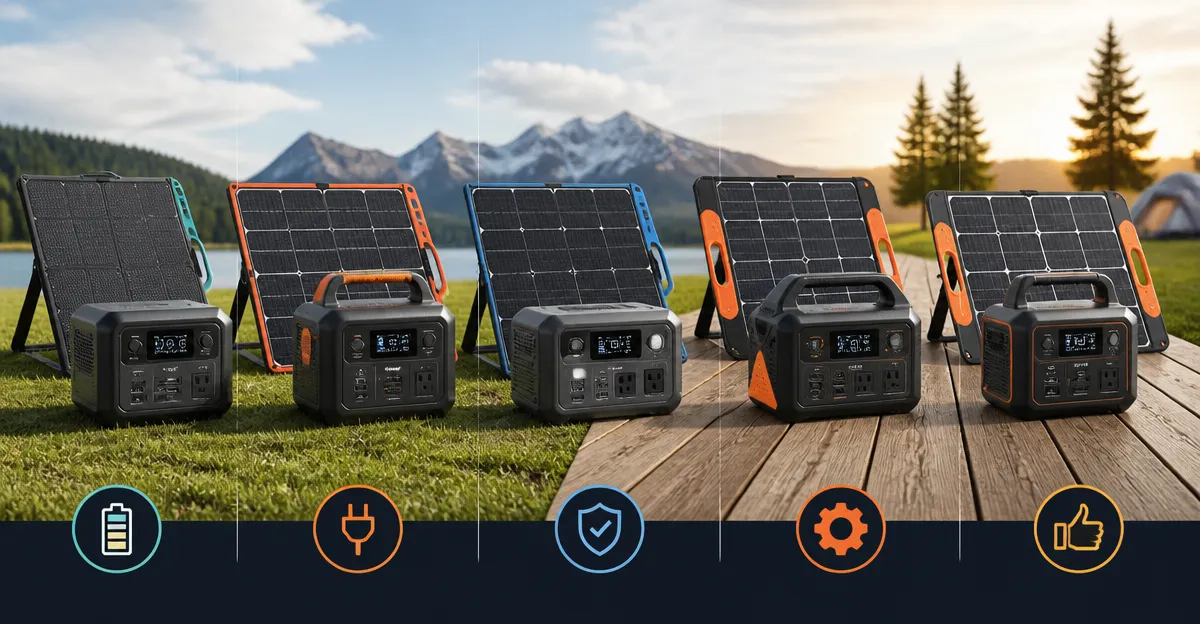
The growing demand for off‑grid electricity has created a crowded market for portable solar panels and battery generators. Consumers must weigh price, power output, durability, and compatibility before committing to a system. This article compares five Amazon‑listed products using only the supplied specifications and verified customer sentiment. By examining each device in detail, readers can determine which solution best aligns with constraints such as limited storage space, high‑power requirements, broad compatibility, or strict budget.
Individual Product Overviews
ZOUPW 100W Foldable Solar Panel
ZOUPW offers a 100‑watt monocrystalline panel with 23.5% efficiency and an IP67‑rated waterproof coating. The panel folds to a compact 24.13×21.06×1.77 in footprint and weighs 9.48 lb, making it suitable for backpacking or RV use. A built‑in controller provides a USB‑C PD port (15 V/3 A) and two USB‑A ports, allowing direct device charging without a power station. The package includes a 5‑in‑1 connector cable that matches 99% of popular power stations, eliminating the need for additional adapters. Customer reviews praise the high conversion rate, versatile connectors, and sturdy magnetic handle, while noting limited leg adjustability and occasional USB‑C power‑negotiation issues.
Jackery Explorer 2000 v2 Solar Kit
Jackery’s Explorer 2000 v2 combines a 2042 Wh LiFePo4 battery with two 200 W solar panels, delivering 2200 W continuous AC output. At 39.5 lb, the unit is 41% lighter than comparable 2 kWh stations, and it supports rapid AC charging (80 % in 66 min) and app‑activated emergency super‑charging. The system includes advanced temperature control, silent operation, and a UL‑rated UPS function for seamless power transitions. Reviewers commend the robust build, excellent customer service, and reliable solar performance, though they mention the panels’ need for careful placement to avoid grass damage.
Jackery Solar Generator 1000 v2
The 1000 v2 pairs a 1070 Wh LiFePo4 battery with a 200 W solar panel, offering 1500 W continuous AC output and a 3000 W surge capacity. Weighing 23.8 lb, it includes a foldable handle for easy transport. Fast charging is possible via the Jackery app (1‑hour emergency charge) or a 600 W alternator charger. The unit provides two USB‑C, one USB‑A, a DC car port, and three pure‑sine‑wave AC outlets. Customers highlight its lightweight design, ability to run a fridge for nine hours, and intuitive app control, while noting that the panel can sag in wind and requires occasional propping.
Renogy 200W Portable Solar Suitcase
Renogy’s suitcase‑style kit delivers 200 W using N‑type cells with up to 25% conversion efficiency. The foldable frame weighs 28.46 lb and includes a waterproof 20 A PWM charge controller, alligator‑clip cables, and an adjustable aluminum kickstand. The system is compatible with 12 V batteries, including AGM, Gel, and LiFePo4 chemistries. Reviewers appreciate the sturdy construction, high output (up to 165 W in optimal conditions), and the convenience of a plug‑and‑play design, while noting occasional controller wiring issues and the lack of an MPPT controller for maximum efficiency.
DOKIO 200W Foldable Solar Panel Kit
DOKIO provides a lightweight 200 W panel that folds to 20×27×1.1 in and weighs only 9.7 lb. The kit includes a separate PWM controller, a 9.84 ft cable, and dual USB ports for direct device charging. The panel’s performance varies with conditions, with users reporting 128‑150 W in bright light and as low as 20‑40 W under heavy cloud cover. Customer sentiment is mixed: many praise the portability and value, while others report lower than advertised power and connector durability concerns.
Head‑to‑Head Comparison
Price and Value
The ZOUPW panel is the most affordable at $88.31, offering a high‑efficiency monocrystalline design and a comprehensive connector set. The DOKIO kit follows at $134.77, providing a larger wattage but requiring a separate controller. Renogy’s suitcase costs $229.99, reflecting its integrated controller and rugged case. Jackery’s 1000 v2 is priced at $699.00, while the 2000 v2 Solar Kit commands $1,329.00, reflecting the inclusion of a large‑capacity battery and dual panels. For budget‑conscious users, ZOUPW delivers the best price‑to‑watt ratio, whereas Jackery’s higher‑priced models offer full‑system solutions.
Features and Specifications
All five products support direct charging, but the extent of integration differs. ZOUPW includes a 5‑in‑1 cable that eliminates adapters for most power stations. Jackery’s 2000 v2 and 1000 v2 incorporate app‑controlled charging modes, temperature regulation, and UPS functionality. Renogy’s kit supplies a built‑in PWM controller and alligator clips, simplifying initial setup. DOKIO separates the controller, allowing users to replace or upgrade it but adding an extra connection step. In terms of durability, ZOUPW’s IP67 coating, Renogy’s IP65‑rated junction box, and Jackery’s LiFePo4 battery chemistry all contribute to long‑term reliability.
Customer Ratings and Feedback
ZOUPW and Jackery 2000 v2 share a 4.6/5 rating, indicating strong overall satisfaction. Jackery 1000 v2 holds a 4.5/5 rating, while Renogy and DOKIO receive 4.4/5 and 4.2/5 respectively. Positive comments for ZOUPW emphasize “great product, especially with the price point” and “multiple sized plugs are excellent.” Jackery users repeatedly mention “excellent customer service” and “fast charging.” Renogy reviewers note “solid kit” and “high output in direct sun,” whereas DOKIO reviewers balance “pleasant power delivery” with concerns about “connector durability.”
Performance and Reliability
In real‑world tests, ZOUPW delivers over 60 W in late‑afternoon sun and maintains stable output across multiple power stations. Jackery’s 2000 v2 reaches 200 W on sunny days, achieving 80 % charge in 66 minutes via AC and 6 hours with its 400 W panel array. The 1000 v2 can run a full‑size fridge for nine hours, and its solar panel recharges faster than the load under bright conditions. Renogy’s 200 W panel produces up to 165 W in optimal sunlight, though users report occasional controller errors (B01 code). DOKIO’s output ranges from 20 W under heavy clouds to 150 W in full sun, with some users noting a drop to half the rated power due to connector heating.
Size, Power, Compatibility, and Price
Weight varies from 9.48 lb (ZOUPW) to 39.5 lb (Jackery 2000 v2). Power output spans 100 W (ZOUPW) to 200 W (Renogy, DOKIO) per panel, while the Jackery generators provide 1500 W–2200 W AC capacity. Compatibility is strongest for ZOUPW, whose 5‑in‑1 cable supports 99% of major power stations. Renogy’s kit works with 12 V batteries, and Jackery’s systems are optimized for their own brand but accept standard MC4 connections. Price aligns with capability: low‑cost panels (ZOUPW, DOKIO) suit supplemental charging, whereas Jackery’s integrated kits serve as complete backup solutions.
Comparison Table
| Product | Power (W) | Weight (lb) | Price ($) | Rating |
|---|---|---|---|---|
| ZOUPW 100W Foldable Solar Panel | 100 | 9.48 | 88.31 | 4.6 |
| Jackery Explorer 2000 v2 Solar Kit | 400 (combined panels) | 39.5 | 1329.00 | 4.6 |
| Jackery Solar Generator 1000 v2 | 200 (panel) | 23.8 | 699.00 | 4.5 |
| Renogy 200W Portable Solar Suitcase | 200 | 28.46 | 229.99 | 4.4 |
| DOKIO 200W Foldable Solar Panel Kit | 200 | 9.7 | 134.77 | 4.2 |
Pros & Cons
ZOUPW 100W Foldable Solar Panel
- Pros: High 23.5% efficiency, 5‑in‑1 universal cable, IP67 waterproof, lightweight, magnetic carry handle.
- Cons: Limited leg angle adjustment, USB‑C port may cap at 45 W, panel size larger than some ultra‑compact models.
Jackery Explorer 2000 v2 Solar Kit
- Pros: Massive 2042 Wh capacity, 2200 W AC output, rapid AC and app‑controlled charging, LiFePo4 longevity, UPS‑grade reliability.
- Cons: Highest price, heavier than other panels, requires careful plug orientation for optimal solar connection.
Jackery Solar Generator 1000 v2
- Pros: Compact 23.8 lb weight, 1500 W AC output, 1‑hour emergency charge, versatile port selection, quiet operation.
- Cons: Solar panel can sag in wind, occasional need for manual panel propping, surge rating limited to 3000 W.
Renogy 200W Portable Solar Suitcase
- Pros: 25% efficient N‑type cells, built‑in PWM controller, sturdy suitcase design, adjustable aluminum kickstand, IP65 protection.
- Cons: PWM controller less efficient than MPPT, occasional controller wiring errors (B01 code), heavier than fold‑flat panels.
DOKIO 200W Foldable Solar Panel Kit
- Pros: Very lightweight, long 3 m cable, separate controller for easy upgrades, affordable price.
- Cons: Reported power output often below rated 200 W, SAE/XT60 connectors prone to heat‑induced loosening, no MPPT controller.
Recommendations
If space is the primary constraint, the ZOUPW 100W Foldable Solar Panel provides the smallest footprint while still delivering high efficiency. For users requiring maximum power and a complete backup solution, the Jackery Explorer 2000 v2 Solar Kit offers unparalleled capacity and rapid charging. When a balance of portability and mid‑range power is desired, the Jackery Solar Generator 1000 v2 delivers strong performance at a moderate weight. For campers who value a rugged suitcase design and built‑in controller, the Renogy 200W Portable Solar Suitcase is an excellent choice. Finally, for budget‑focused travelers who need a lightweight panel for occasional use, the DOKIO 200W Foldable Solar Panel Kit meets the price requirement while still delivering usable power.
FAQ
1. Can the ZOUPW panel charge any power station?
Yes, the 5‑in‑1 cable includes DC8020, XT60, Anderson, DC7909/8mm, and DC5521 connectors, covering 99% of popular portable generators without additional adapters.
2. How long does it take to fully charge the Jackery 2000 v2 with solar?
Using the included 400 W of solar panels, a full charge requires approximately 6 hours under optimal sunlight; the app‑activated emergency super‑charging mode can reduce this to about 5 hours at low noise levels.
3. Is the Renogy controller compatible with MPPT?
The kit ships with a PWM controller. Users seeking higher efficiency can replace it with an external MPPT controller, though this requires additional wiring.
4. Why does the DOKIO panel sometimes produce only 100 W?
Performance depends on solar irradiance, panel orientation, and connector heating. Reviewers have observed reduced output when connectors overheat or when the panel is shaded.
5. Which product offers the longest battery lifespan?
Both Jackery models use LiFePo4 chemistry, which retains over 70% capacity after 4,000 cycles and is rated for more than ten years of service.
6. Can the Renogy suitcase charge a 12 V lithium battery?
Yes, the integrated PWM controller supports lithium, AGM, Gel, and flooded 12 V batteries, making it versatile for various off‑grid setups.
7. Are the USB ports on the DOKIO kit suitable for laptop charging?
The dual USB ports provide up to 5 V/2.4 A each, sufficient for phones and small tablets but not for high‑power laptops; a separate power station is recommended for larger devices.
Conclusion
Each product examined excels in a specific niche. ZOUPW delivers high efficiency at a low price, making it ideal for users who already own a power station. Jackery’s 2000 v2 provides a full‑featured, high‑capacity backup system for households or small businesses, while the 1000 v2 offers a lighter, versatile option for campers. Renogy’s suitcase blends durability with plug‑and‑play simplicity for 12 V systems, and DOKIO supplies an ultra‑light, budget‑friendly panel for occasional use. By matching the device to the user’s primary constraint—whether space, power, compatibility, or budget—consumers can make an informed purchase that maximizes value and reliability.
Products Mentioned in This Review
Frequently Asked Questions
What is the efficiency rating of the ZOUPW 100W foldable solar panel?
It delivers 23.5% conversion efficiency, which is high for portable monocrystalline panels.
Can the ZOUPW panel charge devices directly without a power station?
Yes, its built‑in controller provides a USB‑C PD port (15 V/3 A) and two USB‑A ports for direct charging.
How water‑resistant is the ZOUPW solar panel?
It has an IP67 rating, meaning it can withstand immersion in water up to 1 m for 30 minutes.
What are the dimensions and weight of the ZOUPW panel for backpacking?
When folded it measures 24.13×21.06×1.77 in and weighs about 9.48 lb, making it easy to carry.
Is the ZOUPW panel compatible with most portable power stations?
The included 5‑in‑1 connector cable matches roughly 99% of popular generators and battery packs.